Siskiyou County Election Early Results: Public Safety Measures Lead, Mount Shasta Council Race Separated by Just Three Votes


Local voters support funding for essential services while showing notable differences from California in state and federal races.
By Anastasia Sprout | Mount Shasta Observer | November 4, 2026
Election Day is behind us, but the counting continues across Siskiyou County. Early results reveal strong support for local public safety and school funding, close City Council races, and some striking differences between how Siskiyou County and California voted.
According to the Siskiyou County Elections Office's November 4 report, 12,442 ballots have been counted, representing 44.91% of the county's 27,706 registered voters.
All results remain preliminary.
Mount Shasta City Council: Just Three Votes Apart!
Five candidates are competing for two seats on the Mount Shasta City Council.
| Candidate | Votes | Percentage |
|---|---|---|
| Kenji Guy Dorsey-Imabori | 412 | 26.56% |
| Tim Stearns | 340 | 21.92% |
| Wendy Warnick | 337 | 21.73% |
| Vicki Barr | 264 | 17.02% |
| Roslyn McCoy | 198 | 12.77% |
Dorsey-Imabori holds the lead, while Stearns is ahead of Warnick by just three votes for the second available seat.
The election follows months of changes at Mount Shasta City Hall, including senior leadership turnover, a new city manager, questions about financial oversight, and public debate surrounding a controverisal data center development idea.
What the Leading Candidates Said
The Mount Shasta Observer covered the September 19 candidates forum at Sisson Elementary School, where four of the five candidates discussed their priorities.
Kenji Guy Dorsey-Imabori spoke about growing up in Mount Shasta and wanting younger generations to be able to afford to remain here. He emphasized better communication with residents, opportunities for young people, and preserving the town's character.
“I don't want to watch my town be bought and sold to the highest bidder,” he told the audience.
Tim Stearns emphasized his previous City Council experience, the city's financial challenges, and the importance of funding city services. He also discussed affordable housing and development at The Landing, and expressed opposition to a data center in or near Mount Shasta.
“I oppose locating a data center in or near Mount Shasta,” Stearns stated.
Wendy Warnick, trailing Stearns by only three votes, emphasized her business experience, support for local businesses, affordable housing, and what she called “smart growth.” She spoke about bringing people together while preserving Mount Shasta's small-town atmosphere.
All three expressed support specifically for Measure H.
The forum also included Roslyn McCoy, who emphasized citizen involvement, protection of local water resources, and transparency regarding city spending.
Candidate Vicki Barr was unable to attend.
Read the Observer's full Mount Shasta City Council Candidates Forum Review: https://mountshastaobserver.com/mount-shasta-city-council-candidates-forum-review/
Voters Support Public Safety, Schools, and Fire Protection
Several local funding measures are receiving strong support in early returns.
| Measure | Yes | No |
|---|---|---|
| H — Mount Shasta sales tax | 65.89% | 34.11% |
| J — Mount Shasta school bond | 68.43% | 31.57% |
| K — Weed sales tax | 62.56% | 37.44% |
| G — Yreka hotel tax | 57.43% | 42.57% |
| L — Mount Shasta Fire District spending limit | 72.35% | 27.65% |
Mount Shasta's Measure H would establish a 1% local sales tax to support public safety and other city services. As a general tax, the revenue would enter the city's general fund rather than being legally restricted to police or fire services. City officials have repeatedly emphasized that public safety is a priority for the additional funding.
Measure J would authorize $9.1 million in bonds for improvements to Mount Shasta elementary schools, while Measure L would authorize a revised spending limit for the Mount Shasta Fire Protection District without itself creating a new tax.
Both are currently above their required approval thresholds of 55% and two-thirds, respectively.
The results suggest that many local voters are willing to support additional funding for essential services, even as communities face rising costs.
Siskiyou County Votes Differently From California
One striking contrast is the race for California's 2nd Congressional District.
Republican Robin Littau leads Democratic incumbent Jared Huffman in Siskiyou County, with 55.22% to 44.78%.
Across the full congressional district, however, Huffman has been projected the winner by the Associated Press. An early NBC News tally showed Huffman receiving 75.4% of the districtwide vote, compared with Littau's 24.6%.
The contrast extends to statewide offices.
| Race | Siskiyou County leader | California statewide leader |
|---|---|---|
| Controller | Morgan (R), 55.7% | Cohen (D), 63.9% |
| Treasurer | Hawks (R), 57.0% | Kounalakis (D), 64.2% |
| Attorney General | Gates (R), 57.3% | Bonta (D), 63.9% |
Siskiyou County faces issues that may receive less attention in larger population centers: forest management, wildfire prevention, water resources, agriculture, rural law enforcement, and the economic survival of small communities.
These voting differences raise an important question: How can rural communities ensure their concerns are heard when their political preferences differ substantially from those of the larger electorate?
City Council Races Across Siskiyou County
Other communities are also choosing local leadership.
| City | Candidates currently leading |
|---|---|
| Dorris | Eric Ray Stafford, Donald “Duck” Clontz Sr. |
| Dunsmuir | Michael Clarno, Alan Clother, Matthew Bryan |
| Etna | John Stacher, Jason Deppen, Brandon Fawaz |
| Montague | Gregory Johnson, Patrick Vela |
| Weed | Marie Gates-Green, Darrell Parham |
| Yreka | Colleen Baker, Rhetta Hogan, Jason Williams |
These are preliminary leaders in the regular council races. Etna and Montague also have separate short-term contests.
In Yreka, Jason Williams holds third place with 925 votes, followed by Ian Davis with 872. Three council seats are available.
California Propositions: The Billionaire Tax
California voters considered 14 statewide propositions, including three connected to a proposed tax on billionaires.
Proposition 40 would impose a one-time 5% tax on California billionaires, primarily to fund healthcare.
Proposition 41 would require audits of programs funded by certain taxes and place restrictions on state spending-limit exemptions.
Proposition 42 would prohibit new state taxes on personal property, including financial assets, and certain retroactive taxes.
Here's the connection: Propositions 41 and 42 could block the billionaire tax proposed under Proposition 40. The measures contained provisions addressing what would happen if voters approved competing propositions.
Siskiyou voters rejected Proposition 40 but supported Propositions 41 and 42. Statewide voters showed the same general pattern in preliminary results.
| Proposition | Siskiyou Yes | California Yes |
|---|---|---|
| 40 — Billionaire tax | 33.2% | 38.1% |
| 41 — Tax audits and spending limits | 56.8% | 52.2% |
| 42 — Restrictions on property taxes | 64.7% | 60.2% |
| 43 — Local tax rules | 53.3% | 49.6% |
| 45 — Environmental review | 54.9% | 45.9% |
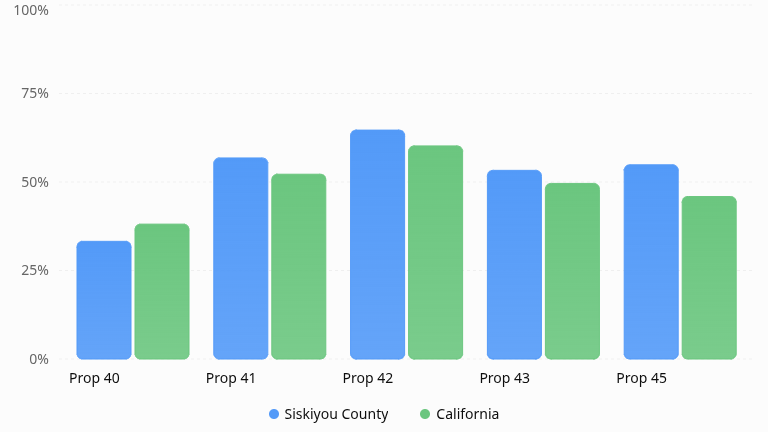
Siskiyou voters also showed greater support than California overall for Proposition 43, concerning local taxes, and Proposition 45, concerning environmental review of development projects.
Proposition 45: W.A.T.E.R. Warned of Threats to Environmental Protections

Proposition 45 has particular significance for Mount Shasta, where residents have spent years debating development, water protection, and the public's right to participate in decisions affecting the land.
The measure would change California's Environmental Quality Act (CEQA), which requires environmental impacts to be studied and disclosed before certain development projects can proceed.
Local environmental organization We Advocate Thorough Environmental Review (W.A.T.E.R.) publicly urged voters to reject Proposition 45, warning that it would weaken environmental protections and limit opportunities for public participation.
In a newsletter titled Billionaires Want to Gut CEQA, W.A.T.E.R. argued that the measure could make it easier to fast-track projects involving data centers, forest clear-cutting, dams, pipelines, and other developments with potentially significant environmental consequences.
The organization also warned that Proposition 45 would restrict tribal consultation by requiring notification only of federally recognized tribes, potentially excluding California tribes without federal recognition from important parts of the environmental review process.
That concern is particularly relevant to the Winnemem Wintu Tribe, which has long sought federal recognition.
W.A.T.E.R. and the Winnemem Wintu Tribe previously challenged environmental approvals involving the Crystal Geyser bottling plant near Mount Shasta, winning an important appellate court decision in 2022.
The case illustrates how CEQA has provided local communities and tribal representatives with a legal means of challenging environmental decisions.
Despite W.A.T.E.R.'s public opposition, Proposition 45 received 54.86% Yes votes in Siskiyou County, compared with approximately 45.9% statewide in the preliminary returns reviewed.
The result is especially interesting given the ongoing discussion about a possible AI data center at the former Crystal Geyser facility and other proposed developments around Mount Shasta.
Supporters of Proposition 45 argued that changes to environmental review could reduce delays and costs for development. Opponents warned that streamlining could come at the expense of environmental safeguards and meaningful community involvement.
Read W.A.T.E.R.'s statement opposing Proposition 45.
What Happens Next?
Siskiyou County election officials will continue counting eligible ballots before certifying the results, with county certification due by December 3.
Mount Shasta's City Council race will be especially important to watch, given the three-vote margin separating Stearns and Warnick.
The Mount Shasta Observer will continue following the final election results.
Editor's Comment
Elections determine who takes office, but what happens next is up to all of us.
Our newly elected representatives deserve a chance to succeed, whether we voted for them or not. Supporting them doesn't mean setting aside our questions or concerns. It means working with them, offering ideas, and holding them accountable while recognizing that public service is no small undertaking.
The same goes for the measures we've voted on. Whether we supported or opposed them, we have a responsibility to pay attention to how public funds are spent, whether promises are kept, and what changes actually reach our communities.
Here's a simple invitation: Attend a City Council or Board of Supervisors meeting. Introduce yourself to a representative. Thank someone for stepping up to serve. Bring a concern, a suggestion, or an offer to help. Better yet, invite a neighbor to come along.
We don't have to agree on everything. We're neighbors, after all, and we share this beautiful place we call home.
The real measure of an election isn't just who wins. It's what we all build together afterward.
Sources
- Siskiyou County Elections Office — Election Results
- Mount Shasta Observer — September 2026 City Council Candidates Forum Review
- NBC News — Congressional election results
- North State Public Radio / Associated Press — Election reporting
- The Ballot Book — Preliminary statewide proposition results
- W.A.T.E.R. — Billionaires Want to Gut CEQA
- California Legislative Analyst's Office — Ballot Proposition Analyses
County, districtwide, and statewide percentages reflect preliminary reporting snapshots and may change as additional ballots are counted.
Comments ()